

Hello all,
As part of my initial efforts to get to grips with the social-democratic women’s magazine, Die Gleichheit, which was edited by Clara Zetkin between 1891 and 1917, I plan to make available translations and summaries of some of the fascinating material contained within its pages and to organise podcasts, videos and discussions with experts on the subject.
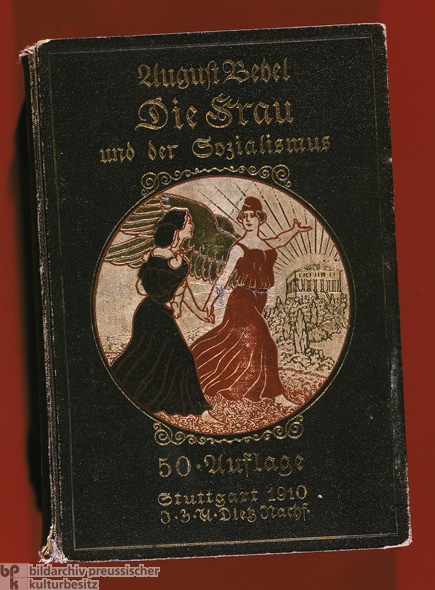
As a small taste of what is to come, I am making available this speech by August Bebel for the first time in English. It was printed in the second volume of Die Gleichheit in early 1892. Bebel was a leading Marxist politician, SPD parliamentarian and orator who was pioneering in his support for the rights of women, homosexuals and those being exploited in the German colonies, with his speeches on these topics often earning the laughter of many a bewildered conservative deputy in the Reichstag. In addition, his book ‘Woman and Socialism’ became was one of the most widely read Marxist texts of the age.
If you like what you see and would like to support my work, then please consider becoming a Patron of this page to help me realise these plans in the coming months and years. Every little helps and it is really encouraging to be part of a growing international community interested in discussing these texts.
I would like to dedicate this translation to the memory of Dr Mark Meaney, a Patron of this page from Colorado, USA, who suddenly passed away earlier this month. My thoughts are with his family and friends.
Best wishes
BL
Bebel’s Speech on the Social Position of Women Today[1]
Held on 15 December 1891 at a public meeting in Berlin.
Twenty years ago, a meeting like ours today would have been impossible: it would have been possible for men to attend, but women would have had difficulties in being here. When it comes to both the legitimacy and the significance of the woman question, we have witnessed a significant turnaround, and in the future the attitudes towards this question will change even more under the pressure of social relations and of the facts themselves. This notwithstanding, the majority of men and women are still of the view that women have no cause to be interested in general or public affairs, that their actual domain is the household, that marriage assigns them, once and for all, to their position in life. In short, they think that existing relations are as they have always been and that they cannot be changed. The latter outlook, however, is utterly wrong: nothing has always been as it is now. This includes the relations between men and women, which have been subject to constant change. In the course of the cultural development of humanity, both the relations between the sexes and marital relations have changed just as much as, and together with, the relations of production and property relations have. Nonetheless, the advocates of today’s state and social order have every reason to present things in such a way as if the property relations, relations of production, as well as marriage and family relations have always been as they are today. For if they concede that, in the course of the cultural development of humanity, all this from its very foundations, and in changing forms, had taken a different shape, then they also must admit that further developments are possible in future too, leaving them without a leg to stand on. When reading the Bible, especially the books of the Old Testament, we learn, for instance, that among the Israelites views prevailed on sexual intercourse that differ most considerably from what in our age is viewed as moral. If, according to the Old Testament, for instance, two such godly men as King David and Solomon could have hundreds of women, without shocking god, then this single fact shows the entirely different character of the time when it comes to what we consider to be moral. In a given period of time, everything that is moral is what the people of that time acknowledge to be moral. But, in turn, morality itself is rooted in the social needs of a particular epoch and among a particular people. And social needs can, in turn, only be fulfilled by the existing mode of production and the existing property forms. So it is that the mode of production is the actual basis for the intellectual, social and political standards of a given society. With the development of the relations of production and property relations, the relations between men and women have changed, the position of women in today’s society has become completely different, and relations have crystallised, which eventually have given rise, in women’s circles too, to the need for an improvement in their position as sexual beings and as members of state and society. Relations are working with ever greater intensity towards making it impossible for women to carry out their so-called natural role of being a housewife, spouse and mother, and instead are forcing them into occupations in craft, trade and industry. Pointing out to women that their natural calling is to be a housewife and a mother is more tasteless in this period than in any other, which is shown, on the one hand, by the constantly growing number of women vis-à-vis men and, on the other hand, by the relatively declining number of marriages. In all modern cultural states the number of marriages is in relative constant decline. This is best shown by France, but also by Germany. Although since 1872 Germany’s population has increased by more than 9 million, the number of marriages even today is considerably less than those in 1872 and 1873. Between 1830 and 1835 in Prussia, there were 1849 marriages per year per 100,000 people. But between 1881 and 1885 it was a mere 1592 and this figure is constantly receding. Numerous socio-economic causes have brought about this decline. It is illusory to assume that apparently such a purely personal affair such as marriage is independent of general social conditions. It is the latter that are solely decisive, and their effect is clearly expressed in the figures cited above. Each year of unusual levels of inflation most significantly reduces the number of marriages and births and so it is that unfavourable social clauses must always have the same effects. Increasingly unfavourable social relations and the growth in demands on life stand in the closest connection with marriages for money and professional marriages, which are increasingly being recorded and show once again how purely economic causes underlie marriage. The Christian image of marriage is in rugged contradiction with the facts. But the material character of marriage also causes quarrels and a large number of unhappy marriages. Men and women increasingly seek what they cannot find within marriage outside of it, but it is just that women are in the least favourable position when doing so. The man allows himself the greatest freedoms and considers these freedoms to be self-evident, but if a woman exercises some of these freedoms then the male world regards this as a crime. The social repression of women expresses itself as a fact in all areas of life. The conditions of marriage I have just described and the great number of obstacles that stand in the way of an early marriage or even getting married at all, create prostitution and turn it into a necessity. Under these conditions, the rise in prostitution is quite inevitable, and those who think that artificial measures such as barracking will be able to limit or repress prostitution merely reveal that they know nothing about the nature of the evil.
The extraordinarily sorrowful conditions under which a large section of women earn a living have a disastrous impact on the growth of prostitution. With their shamelessly low wages and salaries, certain business owners are virtually forcing their female workers and sales assistants etc to prostitute themselves, to sell their bodies. On the one hand, the development that female labour has gone through in capitalism contributes to the growth of prostitution. On the other, it leads to the ruin of family life, the physical degeneration of the race.
When it comes to bourgeois law and the state authorities, it is the woman that is disadvantaged, incapacitated, devoid of rights. The call must therefore be raised for complete equality of both sexes, for the establishment of social conditions that facilitate equality, freedom and justice for all – conditions where there is no longer repression or exploitation. Women must organise themselves as well as the men do – whether in trade unions in association with men, or in women’s unions; they must support their press and related literature that fights for their emancipation. What is more, to the extent that they are excluded from having an influence on either of these things by our public institutions, they must encourage men to get involved. For their part, men must understand what an enormous power factor women’s support for their efforts represents. The Catholic church understood this better than anybody else: it always sought to achieve its main influence through women. In future, the movement behind which the women stand will be the victorious movement.
[1] Published in Die Gleicheit, 2, 25 January 1892, p. 22 [6].